
OVERVIEW
In the world of Berlinguer is a public digital archive dedicated to the international travels of Enrico Berlinguer and, more generally, to the internationalism of the Italian Communist Party and its relations with the Global South.
The project is curated by the Fondazione Gramsci Emilia-Romagna and is funded by the Mission Structure for National Anniversaries of the Presidency of the Council of Ministers, as part of the Maps and Words project. The problem it solves is typical of archival heritage: heterogeneous materials — photographs, posters, publications, archival documents, audio and video recordings — scattered among different preserving institutions, difficult to consult and to relate to one another.
The software gathers them in a single place, describes them in a standardized way, and connects them to the people, countries, and travels they refer to, so that anyone can explore them following the thread they prefer: a date, a country, a face.
The system is composed of two parts: a public website, open and navigable without registration, and a private panel where the Foundation's curators input and organize the materials. The archive is online and operational, and continues to grow as the archival work progresses: the software includes the option to flag as 'in progress' those records that are not yet completed.
01
02
03
They feature a lower-level service panel, accessible only from an authorized network address, for extraordinary maintenance.
Each record gathers a description, dating, conserving institution, source, and one or more associated materials. The materials can be images, PDFs, videos, audio recordings, or references to documents stored on external specialized platforms.
A world map highlights the countries present in the archive; from each, you can access the country profile and related materials.
Documents, travels, and historical context events are arranged on a chronological axis that can be scrolled by dragging, in order to place the materials in their historical moment.

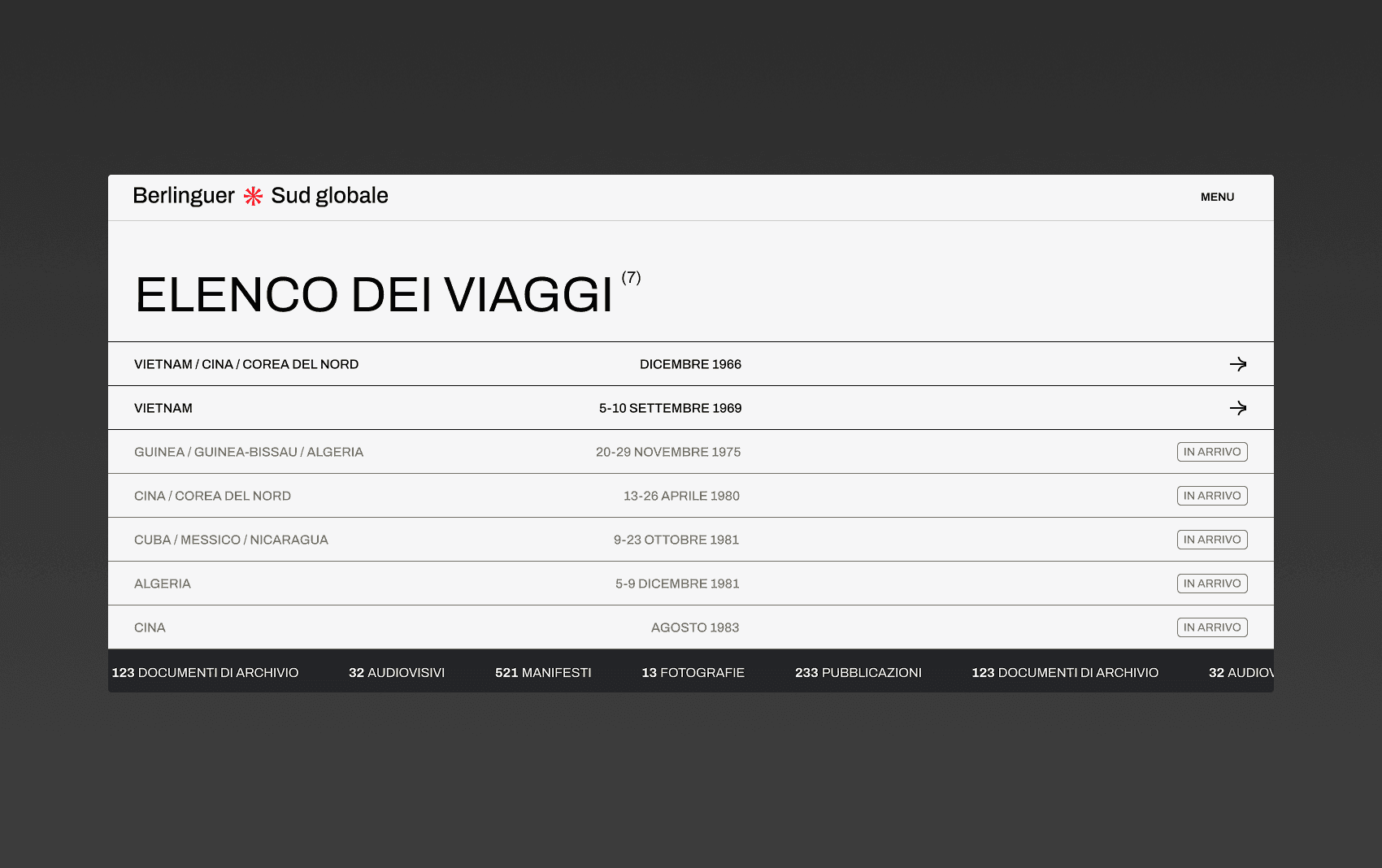
Every trip gathers dates, countries crossed, people involved, and all related documents, with a direct link to the next trip.
Every figure and every country has its own page with a biography or description, an image gallery, and a list of related materials.
Materials can be filtered by thematic section, country, and type; the filters remain in the page URL and are therefore shareable and reusable.
Images zoom and move with the mouse or fingers, PDFs can be flipped through on the page, videos are watched inline; from the open tab you can move to the next document without going back.
Curators insert the materials, define their presentation order, flag the sections still in progress, and rewrite the page texts using an editor similar to a word processing program.
Every uploaded material instantly receives a system-generated thumbnail, starting even from the first page of a PDF: list pages remain lightweight to load.
A banner distinguishes technical cookies from statistical ones; traffic measurement is activated only if the visitor consents.
COMPOSITION
The system is organized into three parts that communicate with each other through a single data exchange point. At the center is the archive: a repository that stores all information and files, and makes them available in a uniform manner to both the public website and the curators' panel.
Around it, there are two distinct applications: the public website, designed to load quickly and be easily indexed by search engines, and the private panel, designed for the precision of editorial work.
Between the archive and the public website, there is a temporary memory that keeps ready the responses for the most visited pages — the homepage, the menu, the timeline — and automatically updates them every time a curator saves a change. This is what allows the website to remain responsive even as the archive grows.
A technical choice deserves to be highlighted because it has visible consequences: the pages of the public website are assembled complete on the server before being sent to the browser.
The visitor receives the content together with the page, and search engines read the pages just as they would read a text document. This is an important requirement for an archive that needs to be found.
STACK
Archive and data exchange
Django, a mature Python framework widely used in the cultural sector and public administration.
Public website and reserved panel
React, the most popular interface library today; the public site also uses a dedicated server that prepares the pages in advance.
PostgreSQL, the benchmark open-source relational database.
Temporary memory
Redis, a fast storage system used to speed up the most frequently visited pages.
Materials
Stored on disk or, alternatively, on a remote storage service compatible with the most popular standards; the choice is a configuration and does not require modifications to the software.
Distribution
The application is containerized, using standardized containers that allow it to be installed on any server without any difference in behavior from one environment to another.

